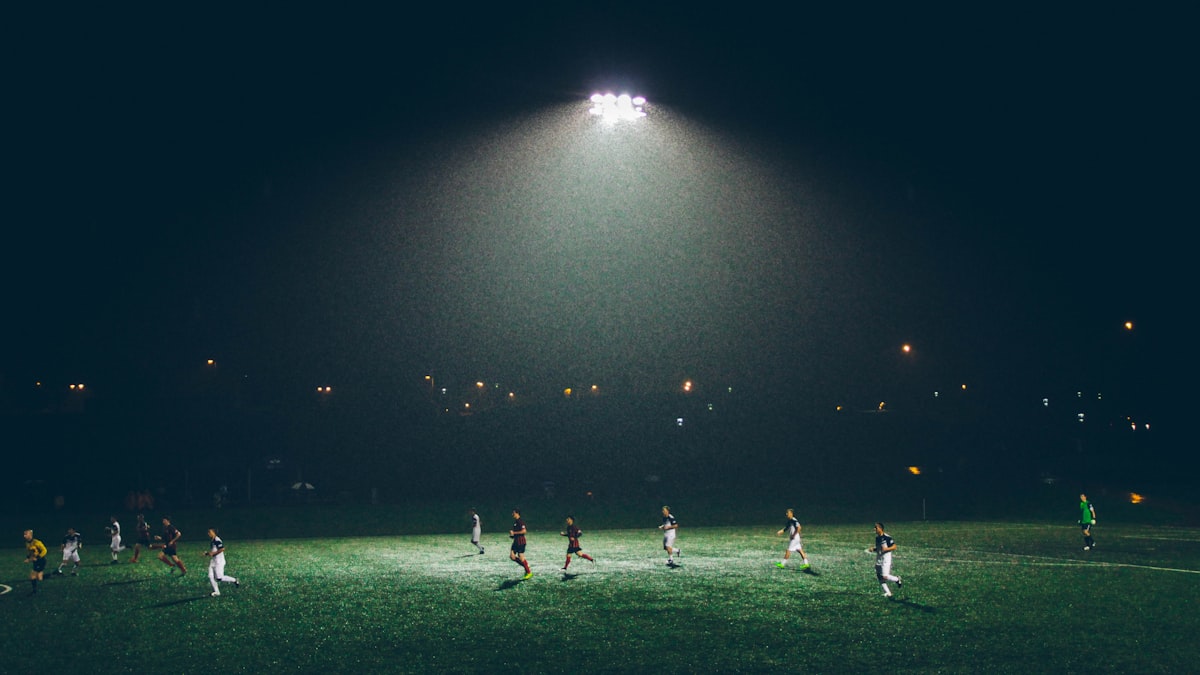
Possession Is Not Control: Build-Up Patterns in the Modern Premier League

Build up play analysis begins with an uncomfortable truth: the team that completes more passes often controls less of the match. What actually separates elite possession sides from decorative ones is the structure they keep while on the ball — the positioning that survives pressure, the pivots that provide escape, and the runs that turn passes into penetration.
Possession is a tool, not an outcome
Possession percentage is the most quoted and least meaningful number in football. It records how often a team has the ball, not what it does with it, and not what the opponent is able to do while waiting. A side can hold sixty per cent of possession by circulating the ball between its two centre-backs while the opposition sits comfortably in a compact block, waiting for the inevitable loose pass. It can also dominate territorially with forty-five per cent, if its possession arrives in dangerous areas and the opponent’s arrives eighty metres from goal.
The distinction that matters is between possession that moves the opposition and possession that merely occupies the ball. Good build-up forces the defending team to make choices: step out or drop, press the full-back or protect the centre, follow the dropping striker or hold the line. Each choice opens something somewhere. Bad build-up lets a defence stand still, and a defence that never has to move never has to make a mistake. That is the standard against which every pattern below should be judged.
Rest defence: the shape that exists before the counter-attack
The most under-appreciated part of build-up is what happens to the players not involved in it. Rest defence is the term for the structure a team maintains while attacking — the arrangement of players designed not to create chances but to prevent them, positioned to either counter-press an immediate turnover or absorb a long transition.
Why two players always stay behind the ball
The core rule is simple: at least two players — usually the deeper midfielder or midfielders, sometimes a covering centre-back — remain positioned behind the ball at all times. Their job is dual-purpose. If the team loses possession, they are already between the ball and their own goal, so the counter-press has anchors to work from rather than a desperate sprint. If the counter-press fails, they are the first line of a settled defence, buying time for the rest of the team to recover. Teams that ignore this — pushing everyone into the attack in search of a moment — are the ones whose highlight reels are intercut with opposition goals.
The second principle is asymmetry. Full-backs advance in a staggered pattern rather than together: one pushes high while the other tucks inside or holds. That way, a turnover never catches both flanks empty at once, and the team retains a diagonal outlet for the switch of play that breaks the opposition’s counter-press. Watch any well-coached possession side and you will see the same signature: as three players attack one wing, one defender quietly patrols the other, doing nothing visible and everything important.
The first line and the pivot
Build-up quality is decided in the first phase — from goalkeeper to the first line of midfielders — because that is where the opposition’s press is strongest and the space behind it is most expensive to lose the ball in. The goalkeeper is the extra man. A keeper comfortable receiving under pressure turns an eleven-v-ten situation in his team’s favour, because the opponent must now commit a presser to the goal area, which subtracts one defender from the rest of the pitch. A keeper who shanks it long under mild pressure converts that advantage into a five-a-side hoof.
The pivot — the deep-lying midfielder — is the hinge of the whole structure. His value lies less in what he does with the ball than in where he receives it: on the half-turn, body open, already facing forward, so that one touch changes the direction of the attack instead of slowing it. A pivot who receives with his back to play compresses his own team’s options to the safe pass he just came from. The positioning is coached relentlessly — the angle of support behind the centre-backs, the distance from the pressing striker, the scanning that happens before the ball arrives.
Third-man runs: the pass that beats a press it cannot outrun
The third-man combination is the signature mechanism of intelligent build-up. The pattern: player A passes to player B, and while the opposition’s pressing structure moves toward B, player C — the third man — runs into the space that the press just vacated. B releases the ball into that run. The ball arrives behind the pressing line from a direction the press structurally cannot cover, because the press’s movement toward B is exactly what opened the space C attacks.
Its power lies in the geometry. A press can mark the first pass and press the receiver, but the third man’s run begins before the second pass exists, so there is nothing to press until the ball is already travelling. Defending it requires anticipation rather than reaction, which is why drilled teams score through this pattern repeatedly while athletic teams fail to stop it. For the defending side, the countermeasure is positional: a defence that keeps one midfielder disciplined in front of its back line — refusing to chase the second pass — breaks the pattern at its source, at the cost of reducing its own pressing numbers.
Baiting: inviting the press onto prepared ground
The most sophisticated build-up does not avoid the press; it harvests it. A team can deliberately look vulnerable — offering a pass into a wide area, holding a midfielder in a position the press will target — to trigger the opponent’s aggressive movement at a chosen moment and in a chosen place. Once the press commits its midfield, the space behind it becomes permanently available, and the baited pass is followed by the line-breaking one.
The prerequisite is courage and preparation in equal measure. Baiting works only if the players can execute the next pass under genuine pressure, and only if the rest defence is sound enough to survive a mistake. It is also score-sensitive: a team trailing by one goal in the seventieth minute baits with far more risk appetite than one protecting a lead, and opponents who read that shift can adjust what they press. From the stands, successful baiting looks almost reckless — a centre-back holding the ball, drawing a striker in, before a lofted pass suddenly changes the entire picture of the game.
The goal kick decision: short, long, or something in between
No phase of build-up is scrutinised more than the goal kick, because it is the one moment every possession team must declare its intentions from a standstill.
When the long ball is the progressive choice
The short goal kick is a means, not a doctrine. It is correct when the opponent presses man-to-man and the extra goalkeeper creates an exploitable overload; it is also correct when the short option draws the press into a prepared trap, as described above. But a short goal kick against a well-organised mid-block that refuses to press simply hands the ball to two defenders and asks them to break ten men’s discipline with no space to run into. In that scenario the long ball — into the striker, into a contested flick-on zone, or aimed at the second ball rather than the first — is genuinely the more progressive pass, because it moves the point of attack forward and forces the defence to defend a different kind of situation.
The best sides mix the two deliberately, varying distribution so the opponent cannot settle into a rhythm. The variety itself is the strategy: a predictable goal-kick pattern is the cheapest scouting report in football.
What to measure instead of possession
If possession percentage is a poor proxy for control, several metrics do the job better. Field tilt — the share of possession in the final third — captures territorial dominance far more honestly, because it weights the ball’s location rather than just its ownership. Pack lines and passes-per-defensive-action measure how much pressure a team can sustain before losing the ball. The location of turnovers matters more than their number: losing the ball in the final third is an attacking weapon, losing it in your own third is a fixture-list liability. And box entries — how often a team moves the ball into the penalty area — correlate with chance creation far more strongly than any passing statistic.
None of these numbers is perfect in isolation, but read together they answer the question possession percentage cannot: who made the game happen, and where? The match centre is the natural place to check these splits after a fixture, and the highlights page rewards re-watching precisely the moments this article describes — the goal kick, the pivot’s first touch, the third-man run — rather than only the goals.
Key takeaways
- Possession percentage measures ball ownership, not control; what matters is whether possession forces the opponent to move and choose.
- Rest defence — two players permanently behind the ball, full-backs advancing asymmetrically — is what turns a turnover from a crisis into a counter-press.
- The pivot’s value is in how he receives, not what he does: on the half-turn, open-bodied, with the next pass already scanned.
- The third-man run beats presses structurally, because the space it attacks only opens once the press has committed.
- Field tilt, box entries and turnover location measure control far better than raw possession — and the long goal kick is sometimes the most progressive pass available.
Frequently asked questions
What does rest defence mean in football?
Rest defence is the defensive structure a team maintains while it is attacking: the players positioned behind the ball to enable a counter-press and, if that fails, to slow the opposition’s transition. It is why elite possession sides concede so little on the break — the shape that creates their chances is simultaneously the shape that protects against them.
Why is possession percentage misleading?
It counts where the ball is, not where it is on the pitch or what it achieves. A team can accumulate large possession in its own half against a settled block, achieving nothing, while its opponent creates more chances from far less of the ball. Location-weighted measures such as field tilt describe territorial control much more accurately.
What is a third-man run?
It is an off-ball run made by a player who was not part of the initial passing combination. Player A passes to B, the defence shifts toward B, and player C attacks the space the defence has just vacated. Because the run starts before the ball is released to him, the pressing team cannot track it without abandoning its structure.
When should a team play short from goal kicks?
Short build-up from the goalkeeper works best against a pressing opponent, where the extra man creates overloads and can bait the press into traps. Against a deep, passive block that refuses to press, the short option offers no advantage, and a direct ball into a target — with players positioned for second balls — often progresses play more effectively.
The question every possession team must answer
The modern Premier League illustrates the whole argument in miniature. The Premier League contains sides that dominate the ball decoratively and sides that dominate matches with less of it, and the difference is never the pass count — it is whether the build-up structure makes the opponent defend things they did not plan to defend. A team with answers to every press, a rest defence that never leaves the counter-attack unattended, and a willingness to go long when long is the progressive choice, controls games in a way that no possession statistic fully captures.
The debate is moving, as analysis always does, toward the next layer: not whether a team’s build-up is structured, but whether its structure is varied enough to survive an opponent who has studied it. The side that recycles the same three patterns can be scouted out of its comfort zone; the side that can change its build-up identity mid-match is far harder to prepare against. For readers watching with that question in mind, the next match becomes a different spectacle — stop counting the passes, and start watching what the ten players without the ball are doing while their team has it.