The Derby della Madonnina: The Story of Milan’s Shared Stadium and Its Derby
The Derby della Madonnina is European football’s most enclosed rivalry: one city, one stadium, two clubs born from the same argument, and a century of history played out under a statue of the Virgin Mary.
One ground, two clubs: how the sharing began
San Siro was built for one club. Opened in 1926, the stadium was conceived during the presidency of Piero Pirelli, the industrialist who led AC Milan and financed a ground in the San Siro district that was then well outside the city’s built area. For its first two decades it belonged to Milan alone, a private stadium at a time when most Italian clubs played on municipal fields — an advantage of ambition and money that shaped the club’s early identity.
Inter moved in after the Second World War, in 1947, when the disruption of the war years made shared facilities the practical answer to both clubs’ needs. What began as necessity hardened into tradition. No other fixture in Europe’s top five leagues pits two clubs of this stature against each other in a shared home, season after season, with the away dressing room only ever a corridor away. The sharing is the derby’s defining fact: neither side can ever truly win home advantage, and both sets of supporters have spent a century treating the stadium as occupied territory rather than neutral ground.
1908: the split that made the derby
Milan came first, founded in 1899 by a group that included Englishmen and was run for years with an English sensibility — the club kept the English spelling of its city in its name, and its early presidents were British. Inter was born in 1908 from a secession inside that club, led by members who wanted a more open approach to signing foreign players at a time when the Football Federation was pushing to Italianise the game. The new club’s name said it plainly: Football Club Internazionale, founded on the principle that talent should be welcome regardless of where it came from.
That origin still colours the rivalry’s folklore. Inter’s founding identity as the cosmopolitan club and Milan’s as the older, more traditional institution have softened into myth, but the first derby was played within months of the split, and the fixture has never since required a pretext. It is one of the few great derbies created by a schism rather than by geography, class or religion — the two clubs are siblings, which is precisely why neither can stand the other.
Inside the stadium: the Curva Sud and the Curva Nord
The Milan end
AC Milan’s supporters hold the Curva Sud, the southern curve of the stadium, and have made it one of the great choreographic venues in European football. The Milan ultras’ tradition runs decades deep: enormous flag displays, coordinated tifos covering the whole curve for derby days, and a chant repertoire that leans on the club’s working-class roots in the city’s east and its history as the club of the people before it was the club of billionaires. The curve’s banners are argumentative — frequently aimed at the other side of the stadium, the city authorities, or Italian football’s governing bodies — and they are treated by the club’s own historians as part of the archive.
The Inter end
Inter occupy the Curva Nord, directly opposite, and the two curves’ sight lines are the derby’s physical architecture: ninety minutes of theatre performed with each audience watching the other as closely as the pitch. The Nerazzurri ultras have their own deep traditions — the club’s founding as the open, internationalist alternative is a recurring theme in their displays — and the northern curve has historically been among Europe’s loudest on derby night. On matchdays the stadium splits cleanly: red and black on one side, blue and black on the other, the main stands divided by custom, and the noise level a running scoreboard of its own.
Meazza and the Madonnina: the stadium’s two names
The building’s official name is the Stadio Giuseppe Meazza, renamed in 1980 after the greatest Italian footballer of the pre-war era, a forward who began at Inter, starred for both Milan clubs and led Italy to World Cups in the 1930s. Meazza is the rare figure both sets of fans claim: Inter’s academy product and record of the era, yet also a Milan player in the 1940s — and the stadium’s name honours a career that crossed the divide.
Fans, however, use the older name. Milan supporters say San Siro, the district’s name, and never the official title; Inter supporters increasingly embrace Meazza precisely because the choice of name is itself a statement of allegiance. The derby takes its popular name from neither: the Madonnina is the golden statue of the Virgin Mary that crowns Milan Cathedral, the city’s traditional highest point and its symbol, and the derby’s winning side has long been celebrated by supporters with flags bearing the statue’s image — the city itself, symbolically, changing hands for a night.
Three rings and a World Cup
From terracing to the double ring
The stadium’s current bulk is the sum of three building campaigns. The 1926 original was a single tier of terracing; an expansion before the war added capacity, and the 1950s brought a second ring that made it one of Europe’s largest grounds.
Italia 90 and the third ring
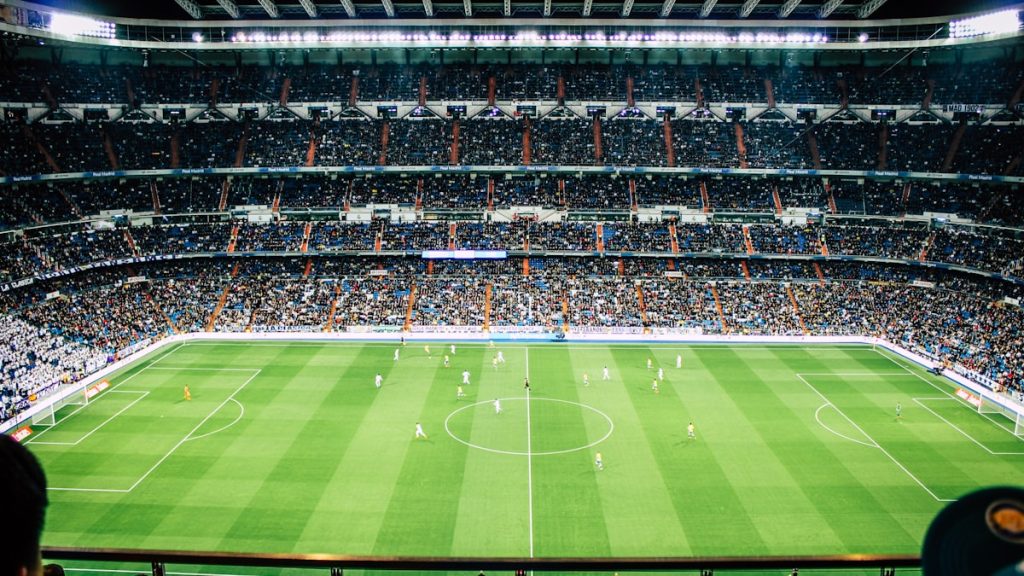
The decisive transformation came for the 1990 World Cup, when Italy built or rebuilt stadiums across the country and San Siro received its third ring, wrapped in concrete towers and spiral ramps that made the structure instantly recognisable worldwide. The capacity settled at around the 75,000–80,000 mark, and the ground hosted World Cup football again — though its elliptical, fortress-like silhouette divided opinion then as now, admired as brutalist theatre by some and dismissed as a concrete relic by others.
The 1990 rebuild left the stadium with its great strength and its great weakness in the same package. The steep third ring puts tens of thousands of seats close to the pitch, which is why the atmosphere survives; but the massive concrete structure, the constrained concourses and the building’s protected status in the public’s affection have made every subsequent modernisation proposal expensive and contentious.
The long argument about a new home
For the past several decades, the future of San Siro has been a permanent item on Milan’s civic agenda. Both clubs have repeatedly concluded what the revenue numbers imply — that a modern, privately owned stadium with hospitality, restaurants and year-round income would transform their finances relative to English and German rivals — and repeatedly stalled on what the history implies, that no replacement could feel like home the way San Siro does. Proposals have come and gone: joint projects to rebuild on the site, separate stadium plans in different suburbs, council elections in which the stadium question was a live issue, and prolonged negotiations over whether the existing structure could be preserved alongside a new build.
The debate matters beyond sentiment. Matchday income at San Siro trails what comparable clubs earn at modern grounds, and Serie A’s wider struggle to modernise its stadiums — explored in the site’s Serie A coverage — has real competitive consequences in transfer markets. Yet the cultural calculation is genuine too: San Siro is to Italian football what no modern stadium is to any league, the shared cathedral of the sport’s most tactically prestigious domestic competition. Whatever is eventually built — and both clubs’ current direction of travel suggests the matter will be resolved one way or another within this decade — the derby itself will outlive the architecture, as it has outlived every previous version of this argument.
Key takeaways
- San Siro opened in 1926 as AC Milan’s privately built ground; Inter joined in 1947, and the sharing has defined the derby ever since.
- Inter were founded in 1908 by a split from Milan over the acceptance of foreign players — a schism, not a geographic divide, created the rivalry.
- The Curva Sud (Milan) and Curva Nord (Inter) face each other, making the derby as much a contest between the stadium’s two ends as between the teams.
- The stadium’s official name honours Giuseppe Meazza, who starred for both clubs; fans’ choice between “San Siro” and “Meazza” signals allegiance.
- The third ring, added for the 1990 World Cup, created today’s 75,000–80,000-capacity bowl — and the decades-long debate over replacing it remains unresolved.
Frequently asked questions
Why is it called the Derby della Madonnina?
The derby takes its name from the Madonnina, the golden statue of the Virgin Mary atop Milan Cathedral and the city’s most famous symbol. The statue represents Milan itself, so a derby victory is framed in local culture as taking possession of the city — hence winning fans flying Madonnina flags after the match.
Do AC Milan and Inter really share the same stadium?
Yes. Both clubs have played their home matches at San Siro — officially the Stadio Giuseppe Meazza — since 1947, with Milan having built the ground in 1926. Each club maintains its own training facilities, offices and museum sections, but on derby day they share the pitch, the tunnels and, divided by their curves, the stands.
How big is San Siro?
Its capacity is roughly 75,000–80,000 after the third ring was added for the 1990 World Cup, making it the largest stadium in Italy. The exact figure has varied over the years with standing and seating reconfigurations, but it remains among the biggest club grounds in Europe and the definitive venue for both Milanese clubs’ biggest nights.
Will AC Milan and Inter build a new stadium?
Both clubs have spent years studying replacements for San Siro, including a joint rebuild of the current site and separate projects elsewhere in the metropolitan area, driven by the matchday revenue gap with modern European grounds. The political and heritage questions around the existing stadium have repeatedly delayed decisions, but the direction of travel across both clubs points toward a resolution in the coming years.
The derby the architecture cannot contain
Strip away the concrete and the argument leaves something that explains Italian football better than any trophy count. The Derby della Madonnina is a rivalry between siblings — same city, same stadium, same founding family — and its history is a century of Italian football’s own story performed twice a year: the fascist era’s Italianisation drive that provoked Inter’s birth, the post-war boom that filled the double-ringed stadium, the tactical golden ages of the 1960s and the 1990s when both clubs were the best sides in Europe, and now a financial era in which the ground itself has become the clubs’ biggest strategic question. The debate over the stadium’s future is therefore not a footnote to the derby but part of it — one more argument between two sets of supporters about what their city is and who owns it. Whichever way the new-build question is settled, the fixture will keep its essential shape: the Curva Sud and the Curva Nord facing each other across the same pitch, as they have for a century, each convinced the ground belongs to them. Recent standings and derby results sit alongside the rest of the season’s data in the site’s league table, and both squads’ current profiles are kept in the club directory — but the derby has never really been about either. It is about a statue, a stadium and an argument that began in 1908 and shows no sign of settling.