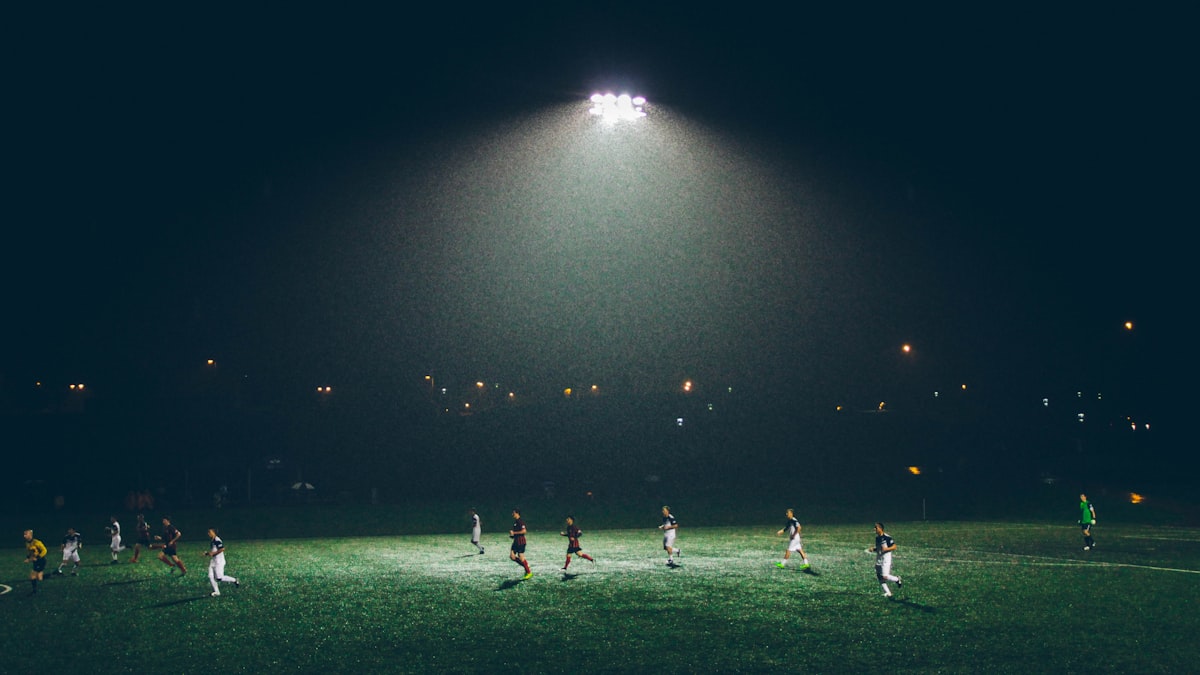
Low block defending turns a football pitch into a series of locked doors: two compact banks of players, small distances between the lines, and a counter-attack waiting behind it all.
The phrase attracts mockery — “parking the bus” — but the mockery misses what is actually happening. A properly organised deep block is one of the most demanding systems in football: it requires hours of collective drilling, relentless concentration and an attacking plan built into its very design. Understanding how it works, and why it frustrates even elite opponents, starts with treating it as a structure rather than as negativity.
A low block is a defensive system in which the whole team defends in the deepest quarter of the pitch: the defensive line sits near the edge of its own penalty area, the midfield a few metres ahead of it, and even the forwards stay within touching distance of the midfield line. The defining choice is about which space to concede. A deep block deliberately surrenders territory — the wide areas, the space thirty metres from goal — in exchange for making the most dangerous zones almost impossible to enter.
That is what separates it from merely “sitting back”. A low block still presses, within its own radius. It still hunts second balls, still springs out when a trigger appears — a heavy touch, a backward pass near its front line. What it refuses to do is chase the ball up the pitch, because doing so would tear apart the shape it exists to preserve. Time-wasting is an absence of intent; a low block is nothing but intent.
The classic structure is two connected banks — the back four and the midfield four — arranged so that the vertical distance between them is too small for an opponent to receive the ball between the lines comfortably. Get the distances right and any pass played into a midfielder or a forward dropping deep arrives with two or three defenders already within a stride of the receiver. That crowding is the block’s core mechanism: it does not need to win spectacular duels, it needs the receiving player to be smothered before he can turn or combine. Every metre of slack between the banks is a gift to a creative playmaker, which is why the discipline to stay connected is drilled harder than any individual skill.
The block defends the centre of the pitch as a priority. It stays deliberately narrow, congesting the central zone and the space in front of goal, and accepts that the wide areas belong to the opponent — because a cross from a deep position is the lowest-quality attacking pass in football when the box is well defended. When the ball does travel wide, the entire block slides toward that side as one connected shape, compressing the space around the ball while the far side tucks in. The touchline becomes a defender in its own right: an opponent receiving in a wide pocket has angles cut off and nowhere to escape.
The most common misconception is that a deep block stands still. In reality it is in near-constant motion, shifting left and right as the ball circulates, stepping up when the ball goes backwards, dropping as it advances. The craft is in the collective movement: ten outfield players moving as a single connected shape, maintaining their internal distances while covering twenty or thirty metres of lateral travel.
Within that movement sit specific jobs. Someone screens the passes into the zone in front of the box. The centre-backs divide the space between the posts and the space between them. The players closest to the ball press it; the next line cuts the outlet; everyone else adjusts position to keep the distances intact. The goalkeeper’s role changes too — he sweeps behind the high line’s absence by defending his box, commands his six-yard area under crosses and starts counters with quick distribution. A deep block that moves as ten individuals concedes constantly; a deep block that moves as one shape can absorb an entire half of pressure without a serious chance against.
A low block is not only a defensive system; it is an engine for manufacturing attacking conditions. By conceding territory, it invites the opponent to commit full-backs, push midfielders forward and leave players up the pitch. Every metre the opponent advances is a metre of space that will exist behind him the moment possession turns over.
That is why deep-defending sides are built the way they are: a centre-forward who can hold the ball and bring it forward, and two or three runners capable of covering fifty metres at speed. The typical successful counter moves the ball forward within a handful of passes, before the opponent’s structure can reform. There is a psychological dividend as well. Attacks that repeatedly break down against the block breed impatience; opponents begin taking risks, throwing more players forward, playing passes they would normally reject. The block does not need to force that impatience. It only needs to survive long enough for the opponent to supply it himself.
No deep block is unbreakable, and the methods used against it are well established. The hard part is executing them against ten players who are all watching the same ball.
The first principle is to make the ball travel further than the block can. Quick switches of play from one flank to the other exploit the moment the sliding shape is caught mid-shift. Overloads in the half-spaces pull midfielders out of the bank; advanced full-backs pin the wide defenders and create two-versus-one situations on the touchline. The most reliable finishing route against a defended box is the cut-back — the ball driven along the byline to a teammate arriving in the space just outside the six-yard area, which the block’s shape struggles to turn around and face.
The deep block accepts long-range shots by design, so good attacking sides make that trade as expensive as possible: crowding the edge of the box to attack rebounds and deflections, shooting from positions that create chaos rather than hoping for wonder strikes. Set pieces are the great equaliser against deep defences, because they bypass the entire structure and turn the match into a contest of rehearsed routines. And patience itself is a weapon: quick restarts catch the block before it resets, while long spells of controlled possession drain the concentration that deep defending demands. Matches against low blocks are rarely lost by one bad pass; they are lost by the thousand small decisions the block forces.
The system’s demands are easy to underestimate. Concentration must hold for the full match, because the distance between a defended situation and a conceded goal collapses to almost nothing — one lapse, one deflection, one set piece. The physical cost is real too: repeated sprint defending from a standing start is more taxing than it looks, and many deep blocks visibly degrade in the final half hour of matches.
Squad construction follows the system. A high line needs pace behind it; a deep block needs aerial dominance, physical centre-backs and a goalkeeper who commands his penalty area. Neither is better in the abstract — they are answers to different questions. The margin for error is simply thinner for the deep block, which is why its practitioners tend to be either the sport’s best-drilled teams or its most desperate ones.
Parking the bus describes an outcome — everyone behind the ball with no plan beyond survival. A low block is an organised system with defined internal distances, pressing triggers inside its own territory and a counter-attacking design. Teams defend deep for entire matches and still create good chances; that is the system working, not negativity. The difference shows in what happens the moment they win the ball.
Because a compact deep block removes precisely the spaces creative players need: nothing between the lines, nothing in behind, and a congested centre. The quality gap between the teams still exists, but it has to express itself through low-value routes — crosses, long shots, contested second balls. Superior teams usually win through width, cut-backs, set pieces and persistence rather than through anything that looks like brilliance.
When its squad profile suits it — physical, aerially strong defenders, a commanding goalkeeper, and fast forwards for counters — and when an open exchange against the opponent is too dangerous. Protecting a lead late in a match and away fixtures against stronger sides are the classic situations. It is a context-specific tool, and treating it as a permanent identity is how mid-table sides get trapped in it.
Yes, but only within a defined radius. Deep blocks spring out when a trigger appears — a bad touch, a loose pass, a receiver facing his own goal near the block’s front line — and press hard for a few seconds to force a mistake or a long clearance. What they never do is chase up the pitch in numbers, because sustained pressing would break the compactness that makes the block work.
As long as possession football defines the sport’s prestige, defending deep will remain the rational answer for every side that cannot win an open exchange. Each tactical generation produces better tools for breaking blocks — better pressing coordination, richer data, more rehearsed set pieces — and the block adapts, narrowing its distances further, adding counter-pressing within its own radius, borrowing ideas from the very systems it opposes. The permanent asymmetry keeps it employed: an attacking move needs many things to go right in sequence, while a defended situation needs only one. The next time you browse match highlights of a favourite team winning comfortably, spend the same time watching the spells when the opponent had the ball, and the whole hidden structure becomes visible — the sliding shape, the crowded receiver, the shape held a metre from disaster. Follow the match centre across a season and the pattern repeats wherever underdogs take points: the deep block is not a relic of negative football. It is the price every dominant side must pay for the privilege of being dominant.